Courier Software Development Company
Build customised courier and logistics software to manage shipments, courier partners, tracking, delivery operations, COD, NDR, RTO, integrations and business workflows from a centralised platform.
PNG Informatics Pvt. Ltd. is a software development and IT solutions company. For courier and logistics businesses, we design and build systems around how your operation actually runs — rather than asking you to change your process to fit a fixed product.
Custom Courier Software Development
Every courier and logistics business works differently. Rate cards, branch structures, courier partnerships and exception handling are rarely the same twice. We develop courier software around those specifics: custom workflows, modules, dashboards, user roles, courier selection rules, pricing logic, reporting and integrations with the systems you already run.
Courier Management Software
A centralised system for shipment booking, pickup, tracking, delivery, billing and customer management.
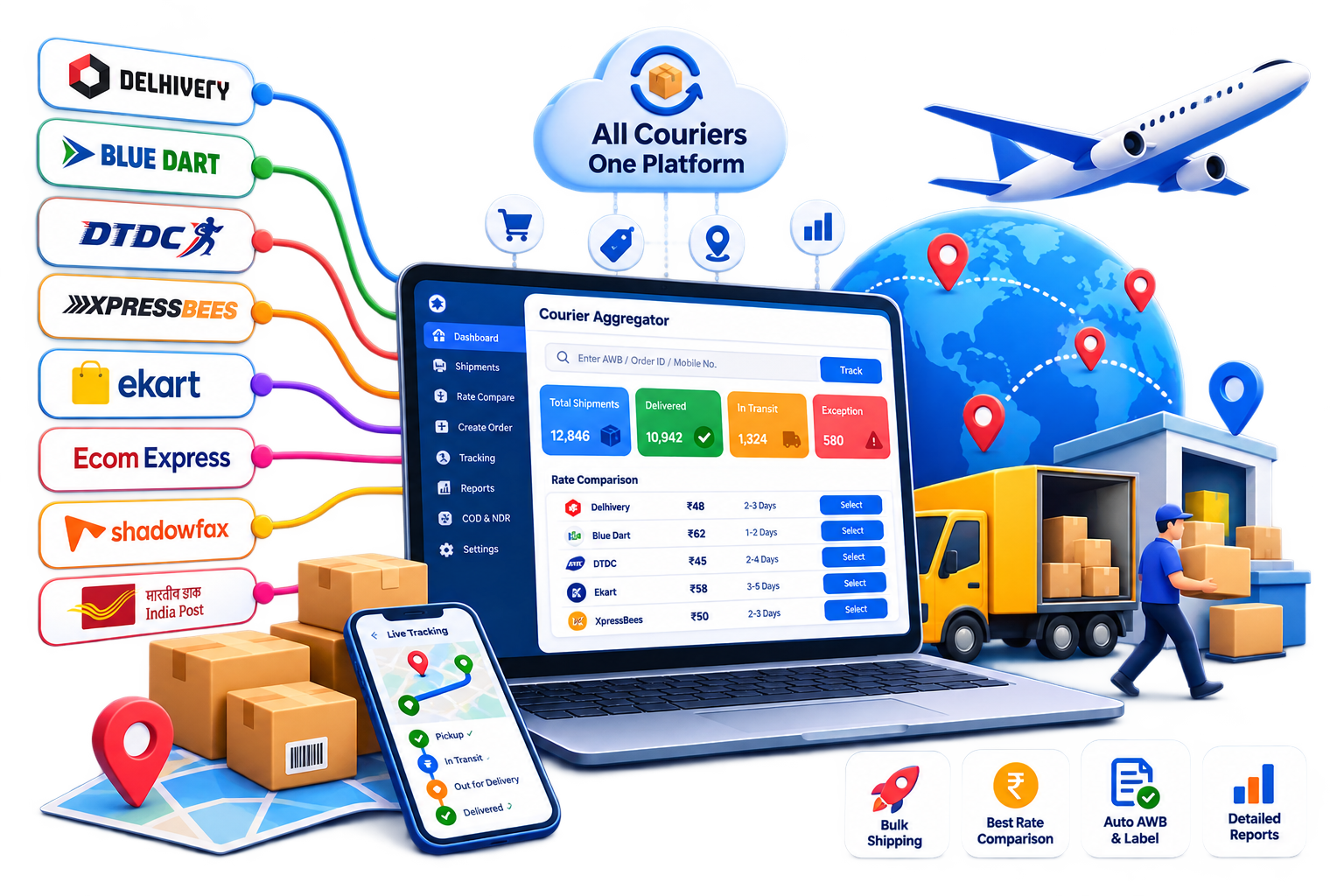
Courier Aggregator Software
A multi-courier platform that connects supported courier partners through one integration layer.
Delivery Management Software
Assignment, routing and final-mile workflows for delivery staff and field operations.
Shipment Tracking Software
Status synchronisation, tracking timelines and customer-facing shipment visibility.
Courier API Integration
Connect your applications to courier and shipping services for booking, labels and tracking.
Courier Mobile Applications
Rider and pickup applications for shipment updates, proof of delivery and COD collection.
Courier Management Software
Courier management software is a system used to manage shipment booking, pickup, tracking, delivery, billing, customer management and courier operations from a single platform.
In practice it replaces the spreadsheets and separate courier portals that most operations accumulate. Staff work in one place, the shipment record stays consistent from booking through to invoice, and reporting comes from one dataset instead of being reassembled each month.
See our existing courier management software capabilities, or read how this connects to logistics management software.
Discuss Your RequirementsShipment Management
Create, edit, cancel and monitor shipments with complete sender, receiver, package, payment and delivery information held in one record.
Courier Booking
Book single shipments or process bulk bookings through file upload or API, with validation rules configured to your business.
AWB Generation
Generate and manage AWB numbers according to your numbering rules or the series issued by a connected courier partner.
Shipping Label Generation
Produce shipping labels and manifests with barcodes, in the formats required by the courier receiving the shipment.
Shipment Tracking
Record shipment events across the journey and synchronise status from connected courier services into a single timeline.
Pickup Management
Manage pickup requests, scheduling, staff assignment and pickup status through to collection.
Courier Aggregator Software Development
Courier aggregator software connects multiple courier or shipping providers through one platform, so shipments can be created, tracked and reconciled across partners without working inside each courier's own portal.
Multi-Courier Integration
Connect supported courier partners through one integration layer, so your team works in a single system instead of several courier portals.
Automated Courier Selection
Configure rules that choose a courier by cost, serviceability, service level or any other logic your business uses.
Serviceability Checking
Validate an origin and destination against a courier's coverage before a shipment is created, reducing failed bookings.
Rate Comparison
Surface the shipping options available for a consignment according to your configured rate cards and partner services.
Centralised Tracking
Normalise status information from different courier vocabularies into one consistent timeline for staff and customers.
Bulk Shipment Processing
Create and process shipments in volume, with order synchronisation for businesses shipping continuously.
How multi-courier software works
An order arrives, either entered by your team or synchronised from a sales channel. The system checks which partners can service the destination, applies your selection rules, books the shipment through that partner's API, returns an AWB and label, then keeps the status updated as the courier reports events.
The part that takes the most work is consistency. Each courier uses its own status vocabulary, and those rarely map cleanly onto one another. A usable aggregator keeps its own status model and translates each partner into it — otherwise your tracking page contradicts itself and support calls increase.
Supported courier integrations depend on the courier provider's available APIs and your business requirements. Which partners can be connected, and how deeply, should be confirmed during requirement analysis.
Workflows an aggregator should cover
- Connecting multiple courier providers through one integration layer
- Automated courier selection by cost, serviceability or service level
- Serviceability checks before a shipment is created
- Centralised tracking normalised across partners
- NDR and RTO workflows handled consistently
- COD collection, remittance and reconciliation
- E-commerce order synchronisation
Courier API Integration
Courier API integration connects your own applications to courier and shipping services, so shipments can be created and tracked programmatically instead of through manual entry.
Our existing courier management system supports integration with multiple courier vendors, including examples such as DTDC, DHL and Delhivery. Actual integrations depend on the courier provider's available APIs, credentials and permissions, and should be confirmed during project planning.
Integration workflows we build
- Shipment creation
- Shipment cancellation
- AWB generation
- Label generation
- Serviceability
- Rate information
- Shipment tracking
- Status synchronisation
- Webhooks
- NDR updates
- RTO updates
- Order synchronisation
Courier Software Features
The modules below are the ones courier and logistics operations most often need. Which of them you actually require — and how each behaves — is decided during requirement analysis.
Shipment Management
Create, edit, cancel and monitor shipments with complete sender, receiver, package, payment and delivery information held in one record.
Courier Booking
Book single shipments or process bulk bookings through file upload or API, with validation rules configured to your business.
AWB Generation
Generate and manage AWB numbers according to your numbering rules or the series issued by a connected courier partner.
Shipping Label Generation
Produce shipping labels and manifests with barcodes, in the formats required by the courier receiving the shipment.
Shipment Tracking
Record shipment events across the journey and synchronise status from connected courier services into a single timeline.
Pickup Management
Manage pickup requests, scheduling, staff assignment and pickup status through to collection.
Delivery Management
Assign shipments to delivery staff, monitor progress and capture delivery outcomes including proof of delivery.
COD Management
Track cash-on-delivery amounts, collection status, transaction records and reconciliation against remittances.
NDR Management
Handle non-delivery reports with configurable reattempt, customer contact and exception workflows.
RTO Management
Track shipments returning to origin, with status, reason codes and the operational handling that follows.
Courier Serviceability
Check whether a courier can service an origin and destination before the shipment is created.
Courier Rate Comparison
Compare available shipping options by configured courier, service level, zone and pricing rules.
Customer Management
Customer profiles, multiple addresses, shipment history, billing records and communication preferences.
Vendor Management
Manage courier partners, service configurations, credentials and integration settings in one place.
Billing & Invoicing
Freight calculation, rate cards, customer invoicing, payment records and COD settlement workflows.
Reports & Analytics
Operational reporting across shipments, pickup, delivery, COD, NDR, RTO, revenue, customers and branches.
User & Role Management
Role-based access so operations, finance, branch and management users see only what they need.
Notifications and communication
Shipment events can trigger notifications through supported SMS, email, WhatsApp and push channels — booking confirmation, out for delivery, delivery confirmation, NDR follow-up and COD reminders. Available channels depend on the providers you use and their integration requirements.
Courier Mobile App Development
Pickup and delivery staff work standing up, one-handed, often with poor connectivity. A mobile application that assumes a stable connection gets worked around, and your tracking data ends up with gaps in it.
Functionality is defined by the roles involved and the scope of the project. We also build mobile applications outside logistics — see our mobile app development services.
Typical rider application features
- Rider login and shift handling
- Assigned shipment list
- Pickup management
- Delivery management
- GPS and location capture
- Barcode scanning
- Proof of delivery
- Photo upload
- Signature capture
- COD collection
- Delivery remarks and NDR updates
- Push notifications
Customer Tracking Portal
A customer-facing tracking page lets a recipient enter an AWB number, tracking number or shipment reference and see where their consignment is, without contacting your support team.
Tracking can run as its own page or be embedded into an existing website or customer portal — see our website development services if the tracking experience needs to sit inside a new site.
What customers can see
- Search by AWB, tracking number or shipment reference
- Current shipment status and tracking timeline
- Pickup, transit and out-for-delivery status
- Delivery confirmation and proof of delivery
- NDR information where a delivery attempt failed
- RTO status for shipments returning to origin
Logistics Software Development
Courier operations are usually one part of a larger logistics workflow. Where the requirement extends past parcels, courier functionality can be built as a module within a broader platform rather than a separate system to reconcile later.
Logistics Management
Transportation, trips, routes, vehicles, drivers and shipment coordination. See logistics management software.
Warehouse Management
Inbound, put-away, stock accuracy, pick-pack and dispatch. See warehouse management software.
Transport & Fleet
Vehicle records, documents, maintenance, utilisation and driver assignment.
Last-Mile Delivery
Final-mile assignment, delivery windows, route sequence and proof of delivery.
E-Commerce & Third-Party Integrations
A shipping system that connects to nothing still leaves staff copying data between screens. Integration is usually where the actual time saving comes from.
Where APIs or other suitable integration methods are available, courier software can be connected to the systems your business already runs. What is possible depends on what each system exposes.
Systems we commonly connect
- E-commerce platforms and online stores
- Marketplace order feeds
- ERP systems
- CRM systems
- Payment gateways
- Courier and shipping APIs
- Warehouse systems
- Custom third-party APIs
Who Can Use Courier Software?
The same underlying modules serve very different businesses. What changes is which parts matter most and how the workflow is shaped.
Courier Companies
Manage bookings, parcels, branches, delivery staff, customers, billing and reporting in one operational system.
Courier Aggregators
Connect multiple courier partners and offer shipping, tracking and reconciliation through a single platform.
Logistics Companies
Coordinate shipments, vendors, delivery operations and customer information across a wider logistics workflow.
E-Commerce Businesses
Connect orders to courier services and automate shipment creation, label generation and tracking updates.
D2C Brands
Manage courier selection, tracking, COD, NDR and customer communication for direct-to-consumer shipping.
Enterprise Businesses
Build internal shipping and logistics workflows that fit existing ERP, CRM and warehouse systems.
Retailers & Distributors
Coordinate outbound dispatch, returns and delivery visibility across locations and channels.
Transport & Delivery Operators
Manage delivery operations, drivers, vehicles, shipments and customer records in a connected system.
Benefits of Custom Courier Software
The gains come from removing repeated manual work and keeping one consistent record of every shipment, rather than from any single feature.
Centralised Operations
Shipments, customers, couriers, billing and reporting live in one system instead of scattered files and portals.
Less Manual Work
Repeated data entry between courier portals and spreadsheets is replaced by integrations and configured workflows.
Better Shipment Visibility
Staff and customers can see where a consignment is without contacting the courier directly.
Faster Processing
Bulk booking, label generation and automated courier selection shorten the time from order to dispatch.
Improved Customer Experience
Tracking pages and status notifications reduce the volume of routine where-is-my-parcel enquiries.
Reliable Reporting
Operational and financial reports come from one dataset, so the numbers reconcile.
Easier Integration
APIs and webhooks connect shipping to the e-commerce, ERP and accounting systems you already run.
Room to Scale
Modules, users, branches and courier partners can be added as the operation grows.
Courier Software Development Process
Most of the risk in a logistics project sits in the requirements, not the code. We spend the early stages on your actual workflow.
Requirement Analysis
We start with how your business actually operates — volumes, users, courier partners, commercial terms and the problems you want solved.
Business Workflow Mapping
Your real shipment journey is mapped stage by stage, because gaps usually sit at the handovers rather than inside them.
UI/UX Design
Interfaces are designed for each type of user: operations staff, finance, branch users, delivery staff and customers.
Architecture Planning
Data model, integration approach, roles, hosting and scalability are decided before development begins.
Development
Web application, modules, dashboards, APIs and mobile applications are built to the agreed scope.
API Integration
Courier, e-commerce, payment, ERP and other third-party connections are implemented and handled for failure cases.
Testing
Workflows and integrations are tested against the defined requirements, including exception paths such as NDR and RTO.
Deployment
The application is released to your chosen hosting or cloud environment with the required configuration.
Support & Enhancement
Modules, integrations and improvements continue as your operation and courier partnerships change.
Why Choose PNG Informatics for Courier Software Development?
PNG Informatics is a software development and IT solutions company. Courier and logistics technology is one of the areas we build in — alongside website development, mobile app development and other business software.
Custom Development
The system is designed around your workflow rather than asking your business to adopt someone else's process.
Courier & Logistics Domain
We already build courier, aggregator, logistics and warehouse systems, so the operational vocabulary is familiar.
Web & Mobile Together
A central web application for operations, with mobile applications for the people working in the field.
Integration Capability
Courier APIs, e-commerce platforms, ERP, CRM, payment gateways and webhooks connected as the project requires.
Scalable Architecture
Built so modules, users, branches and courier partners can be added later without rebuilding.
Custom Dashboards & Reporting
Reports and dashboards shaped around the decisions you actually make, not a fixed template.
Ongoing Enhancement
Software is extended as requirements change, rather than being handed over and left.
More about the company on our about page, or read our writing on courier and logistics technology.
Looking for a courier software development company?
Tell us about your business, your current workflow, the courier partners you work with and the integrations you need. We will come back to you with what it would take to support it — and what we would not recommend building.